
Kelly Timpane is the co-founder of Endlight Entertainment LLC and an Executive Producer ofNinjas v. Zombies(2008), Ninjas v. Vampires(2010), and the upcoming Ninjas  v. Monsters. By day, she is also an HR executive.


How did you get involved with producing?  What is your role specifically?

Those are both great questions Caroline, thanks. I got involved through my husband, Justin, although I had worked for a couple of years  behind the scenes and onstage for Paramount Parks.  Justin has been involved in the entertainment industry pretty much his whole life, and a few years ago he decided to take a step back from acting and get behind the camera.  He and our friend, Daniel Ross, decided they would like to make their own movie together instead of acting in other people’s movies.  So we formed an LLC – Endlight Entertainment – and Justin started writing. My role is pretty much everything on the “business” side.  Justin and I are co-owners of Endlight Entertainment, but he is definitely the creative side, and I’m the business side.  In my “real life”, I am a Human Resources executive, so it was pretty natural for me to step in to the business management side of Endlight.

As Executive Producer on our first two films, my role was pretty much anything that needed to be done on the business or detail-oriented side.  I was involved with casting (we made group decisions on major cast), was a story supervisor and script supervisor, and was the HR and Contracts point-of-contact. That means I put together all the contracts for the actors, crew, musicians licensing agreements, etc. During post-production, my role was often continuity editor and general QA of the film during its rough cuts, and again on the business side – reviewing the terms and conditions of our distribution deals.

You live in DC, so not an obvious filmmaker’s choice.  What challenges AND advantages come from working in a“non-traditional” film geography?

You would actually be surprised how much theatre and film there is in the DC area.  Justin has acted with a number of local theatre companies and independent film companies in the area.  But, yes, when you think of filmmaking, Washington DC is not the first place you would consider.  I think the challenges mostly stemmed from how to get the film out there once it was made, since it’s not like we could walk down to a studio and pitch them our film (does anyone actually do that?)  And we’ve had some challenges in that a lot of the contracts we sign on the post-production side are based out of California, so if we ever had a reason to challenge a contract, we would have to dispute it in a California court… but other than that, we mostly saw advantages to filming in a “non-traditional” area.  The market here is saturated with talented actors in Theatre who would love to get into Film.

It’s also saturated with people who would love the chance to work (crew) on a film but would not normally have the chance if the film were made in NY, LA, or one of the other “typical” film locations.

What is the inspiration behind the Ninjas theme?  Is it something you personally enjoy?  Did you have a business reason?

I have to chuckle at this question.  Justin really was the one who came up with this idea, along with Daniel Ross.  The story goes that they were walking through a Blockbuster looking for movies and thinking about making a movie themselves –trying to figure out what movie guys like them would want to see that hadn’t been made.  One or the other suggested “Ninjas Vs Zombies”.  The idea was to appeal to the late-night college crowd who just wanted some combination of comedy, action and horror – a fun ride to experience. So, not that we don’t like Ninjas but it wasn’t a decision related to our love of a particular genre or character type – it was more a decision to make something fun that hadn’t been done before and that was what sprang to mind.

Do you have a desire to do other films or other subjects outside of horror?  How do you decide?

Personally, I would love to see Endlight do a Romantic Comedy, but I don’t know if I can convince Justin of that.  We really seem to do well with the Action / Comedy / Horror niche so far, and I think we would want to continue in roughly that same genre mix so that we can continue to keep our fan base that we’ve gained with Ninjas. We have said that this upcoming film (Ninjas Vs Monsters, the third in the series) will be the final chapter for the Ninjas.

We’ve been talking a lot about what’s next, but haven’t made any firm decisions yet. The goal right now is to finish this one and take a couple months off before we start down the path to the next one.

What was the capital-raising process like?  For people who did invest, what was the most attractive reason (e.g., they knew you personally, they were interested in the content)?

Honestly, for the first two films, we funded them entirely out of our own pockets (mostly courtesy of Visa & MasterCard).  That was difficult because it’s not like we had lots of extra money just sitting around. But we believed in the projects and wanted to get them made.  For the third film, we did turn to others to raise capital, but did not end up using any “traditional” investors.

We used Kickstarter to raise funds through “crowd funding”, which was  pretty cool.  I hadn’t heard of the  concept before our Executive Producer (and marketing guru) Daniel Ross brought  it up.  We were deciding between two sites that had similar purpose and ended up going with Kickstarter, and were able to raise enough money to meet our goal.  It was a mix of people who knew us (friends& family), fans from the first film, and just people who heard about our campaign through word of mouth or advertisements we had placed.

What financing routes did you consider/ try (e.g., crowd funding, friends & family, formal investors, festivals)?  Which were the most fruitful and what advice would you give aspiring indie filmmakers looking to finance their film?

We really have not explored much in terms of outside financing at this point.  My preference is to keep it simple and either fund it ourselves, or use a crowd funding site like Kickstarter.  Formal investors can be a great thing, but we didn’t want to over complicate things for our first few films.  Of the three films, having financed the first two ourselves and the third almost entirely via donations on Kickstarter, I definitely prefer when other people pay for it!  And it’s still a good deal for the people who donate, because they get to be a part of the filmmaking process, and they get something out of it. For our Kickstarter campaign, depending on the donation amount, we offered memorabilia from the first two films, signed copies of the first films, walk-on roles in the movie, original artwork, or even executive producer credit for the large donations.

How did each movie in the franchise improve over the earlier (either creatively or production-wise)?  How has your role evolved?

As with most things, the more time we have spent on the franchise, the better it’s become.  Justin has become a better writer with each movie, and a better director, and he’s also become better at delegating things to other people and not having to do everything himself.  That’s been a big plus for me, since it means I get more time with my husband and the kids get more time with dad.

Honestly, the progress from  the first film to the second was definitely noticeable.  But the improvements from the second film to the third and final film (Ninjas Vs Monsters) are astronomical!  Creatively, the characters have come so far from where they first started. The story has gotten darker, funnier, more action-packed and is just an exponentially more fun ride as a whole.

Production-wise, the visual look and feel and the overall quality of the practical and digital effects in the films have improved by leaps and bounds each time, and are just mind-blowingly good in this final film, thanks in part to better equipment, but also just as a natural progression of the whole crew getting more experience.  In fact, many members of our crew have been tapped to work on other productions in the area, which just adds more experience under their belt and gives us more filmmakers and actors to network with when making the next film.  You’ll have to watch each of the movies, and then come to the Premiere of Monsters next month to judge for yourself!

What do you know now that you wished you knew when you started?  What advice overall would you give to aspiring filmmakers?

We know a lot more about networking and about finding great locations now.  I wish we had known how to find those connections earlier on, because the first movie could have had way cooler locations than our house and the woods.  And let me tell you, getting zombie blood out of the carpet is no easy feat!  We did have nice locations at a local movie theater and at a local comic shop in the first movie, but we’ve gotten some really awesome looking shots in the second and third films thanks to some incredible locations.  The local film office was helpful in finding places that are open to filmmakers, but  really most of the locations were through networking – a friend of a friend has a place, etc.

Overall, my advice to aspiring filmmakers would be to just go for it.  If you’re passionate about making a film and you have an idea for something you would like to see made – go do it.  Understand that it takes a lot of work, and that not everyone will love it – but even if it doesn’t win a Best Picture at the Oscars, you still made something, and not everyone can say that.

What’s next for you?  For the Ninjas franchise?

The first two Ninjas movies (Ninjas Vs Zombies and Ninjas Vs Vampires) are in distribution now on DVD and digitally. We are proud to announce that the third and final installment (Ninjas Vs Monsters) will have its World Premiere on October 14, during the 2012 Spooky Film Fest at the AFI Theater in Silver Spring, MD.  More information about the Spooky Film Fest can be found at www.spookyfest.com.

After the premiere, we intend to take some time marketing the final film and getting it out there to the fans through as many distribution channels as  possible. Although we are finished with the films, I don’t think the Ninjas universe will be going away anytime soon. We have comic book deals for the first two films already as well as other mediums in development.

Up next for me?  More sleep. I hope. Up next for Ninjas?  Maybe Ninjas vs. Evil HR Directors?  You never know…

For anyone who wants to stay up-to-date on the progress of the Ninjas franchise, you can visit our websites at www.nvzmovie.com,www.ninjasvsvampires.com, or www.ninjasvs.com.  We are also on facebook, twitter (@NinjasVs and @KellyEndlight), and oh yeah, we also have a podcast network – although it’s definitely NSFW.  Check out geeksradio.com or lookup “geeksradio” on iTunes.  Thanks!
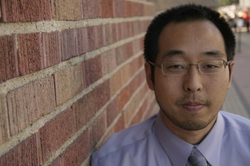
Koji Steven Sakai has written three feature films that have been produced,Haunted Highway (2006),The People I’ve Slept With(2009) and Chink (2012), the last two he also served as a producer. This summer he has another film going into production, Monster & Me, a family/Christmas story. Most recently, his script, Romeo, Juliet, & Rosaline, was optioned by Amazon Studios. In addition to his work in film, Koji is a regular contributor to 8Asians.com, a blog dedicated to Asian American culture, history, and news. He also writes for Discover Nikkei, a community website about Nikkei identity, history and experiences. Finally, he contributed a story (Meet Joe) to Secret Identities: The Asian American Superhero Anthology (New Press 2009), the first graphic novel anthology written/drawn/and about Asian Americans. Koji is also the Manager of Programs at the Japanese American National Museum, where he oversees the National Museum’s exhibitions and public programs, including co-programming the ID Film Festival, which showcases films by Asian Pacific Islander filmmakers for API filmmakers. Koji is a graduate from the University of Southern California’s Masters of Professional Writing program. He has held several prestigious fellowships, including The Producers Guild: Power of Diversity Workshop (2009).


What are you currently working on? What is the latest on Chink?

(Koji) We are in the middle of post-production on my newest film, Chink. It is the first Asian American serial killer movie. It was directed by Stanley Yung and stars Jason Tobin (Better Luck Tomorrow), Eugenia Yuan (Memoirs of a Geisha) and Tzi Ma (Rush Hour). Also, I have a feature currently in production, Monster & Me. It’s a children’s Christmas movie. Other than that, I’m always writing 6-8 screenplays at a time.

How did you come to a film writing career? Did you pursue other types of writing before this? Other arts? Other careers altogether?

(Koji) I always dreamed of becoming a novelist and writing the cliché “great American novel.”  I enrolled at USC’s Masters of Professional Writing program in the hopes of learning how to become an author. But it didn’t work out the way I had planned. My prose wasn’t as good as it needed to be and I even considered dropping out of school. But on a lark I decided to take a screenwriting class with Syd Field. That one class changed everything. I realized then that my calling was not to write the cliché great American novel but the cliché “great American movie” instead.

How does being Asian-American inform your career and project choices?

(Koji) This is a good question. I think a lot of other Asian Americans see being Asian American as being hurtful to their film/writing careers or at the very least making it more difficult for them. However, I don’t believe this. I believe that it can be helpful. Let me explain. One of the advantages of being Asian American in the film business is that there aren’t too many of us. So we all are connected at most by one or two people. I believe there is power in this. This means that if I want to work with another Asian American or just get advice, I can get to them. I don’t know a lot of other communities you can say the same thing.

Being Asian American has not affected my project choices too much. I look for good stories and good characters that I can be passionate about. Other than something overtly racist, I’m willing to try to write a script about it.

Are Asian-Americans supportive of AA films, or is there lack of awareness/ interest?  What is the interest among non-AA? Who is the most supportive of AA work – diversity associations in general, friends & family, specific producers?

(Koji) There are many passionate Asian Americans who are very supportive of Asian American films. Because of them, Asian American film festivals and art/film nonprofit organizations have sprung up all over the country to support and foster Asian American filmmakers.

Outside the community though, most people don’t realize there are Asian American films. When they think of “Asian” movies at all, they think of movies from Japan, China, Korea, etc.

What is your creative process? How do you decide what to write about? What inspires you?

(Koji) I write every day. I always tell people the difference between a professional and amateur writer is that the professional writer writes every day and the amateur writer waits for inspiration.

How do I decide to write about? First, if someone is willing to pay me to write, I’ll write anything. Okay, I’m half joking. To be honest with you, I really do like to write anything and everything. Whenever I jump onto a project my trick is to try to turn it into something that I’d want to watch. Sometimes I have more successful at it than other times.

My inspiration? I dislike questions about inspiration because inspiration doesn’t push me to write. I write because I am a writer. I would write for the rest of my life even if it meant that no one would pay me – but obviously I prefer to make some money.

What was your inspiration specifically for Chink? Did you want to do a “first” (e.g., first AA serial killer movie)? Are you interested in serial killers or that genre?

Originally my producing partners (Quentin Lee and Stanley Yung) wanted to do two movies, one featuring an Asian American female lead and another featuring an Asian American male lead. We wanted to make movies with challenging characters for our actors to play. Roles that most movies (Asian American or otherwise) they don’t get to play. The People I’ve Slept With was the female movie and Chink became the male one. We didn’t set out to write a serial killer script per se, but it naturally developed into that after many many many drafts!

I’ve always been fascinated by serial killers. I’m curious how their brains work and why they do what they do. But I hope to never meet one in real life. 🙂

What do you know now about independent filmmaking that you wish you knew when you started?

(Koji) Advice? Not to make an independent movie. Just kidding. I knew it was hard to make an indie movie but I never really really really understood how hard it was until I started making them. If I can go back and talk to myself I would tell myself to relax and enjoy it while it’s happening and not to let all the stress and headaches of a set get me down.

What advice, whether creative or business focused, would you give to someone interested in writing, directing, producing, or otherwise working on independent films?

(Koji) My advice to anyone in a creative field is not to do it for the money. Because if you do it for the money, you’ll inevitably end up very disappointed. Do it for the love of it. And if you end up making any money at what you love, that’s just a bonus.

What’s next for you, in terms of future projects or career in general?

(Koji) People are going to laugh when they read this but anyone who knows me knows that my goal has always been to eventually write an X-Menmovie. After that, I will die a happy man.

How can people follow your work or learn more about you?

(Koji) Become a fan of my newest film, Chink. People can follow me on Twitter (https://twitter.com/ksakai1) or friend me on Facebook (http://www.facebook.com/koji.s.sakai). I’ll befriend anyone. You can also check me out some of my articles on 8Asians.com, a collaborative blog dedicated to Asian American culture and issues.

Interviewed by Caroline Ceniza-Levine, founding partner of FBC Films

The great thing about the modern age is that DIY filmmaking is easier than ever. There are many aspects to this, but I wanted to take a quick look at one: software. There is a bevy of great, easy-to-use, and FREE software out there for the budding filmmaker. Some of these you know, some maybe not, but I’ll make this easy by just pointing out what free software I have on my MacBook Pro:

-Open Office: No need to purchase the expensive Microsoft Office suite, when Open Office has (essentially) all the same features.

-VLC: Plays every type of video file, which is a must.

-Gimp: The replacement for Photoshop. Missing a few bells and whistles, but there is still no reason why Gimp is not more than adequate enough for professional image post-production. I used to have PS, but ever since I downloaded Gimp there has been no looking back.

-MPEG Streamclip: Great for converting and encoding videos.

-Skype: You need to call people around the world as you network, make production plans, etc. Skype’s got you covered.

-Handbrake: Rips DVDs easily.

-iMovie: Yes, it’s iMovie. But when you only need some basic editing, it gets the job done.

-Sophos Anti-Virus: Macs are finally being targeted by viruses. Good thing Sophos has a basic, free version of their security program.

Look at all the things I can do on my computer for free! After purchasing my MBP, I have not put any money into software; there has been no need.

When I tried to think of successful people in science fiction and horror film who are not white, only one name came to mind: Will Smith. Just look at his resume: Independence Day, the Men in Black franchise, I, RobotI Am Legend (I try to forget Wild Wild West). These have all been large Hollywood films that did quite well financially. I tried to do a little research to see what lessons others could learn from him, and here’s the advice I came up with:

Be a man with a plan.

Not an original thought, by any means. But Will Smith has been driven since he was a teenager, and he has tackled his career with distinct goals in mind. Even sci-fi was a calculated choice, with a 1990 Smith realizing that the top ten grossing films of all time all had special effects involved. So, for multicultural actors looking to make it big, sci-fi is not a bad place to start. But no matter what route you want to take, approach it with a clear plan and a strong work ethic. And who knows? Maybe you’ll even have a blog post written about you one day!

Note: Time did a great piece on Will Smith here (http://www.time.com/time/magazine/article/0,9171,1689234-1,00.html), which is where I pulled the anecdote about the top ten.


Author: Chris Johnson 
Serving up a cerebral smorgasbord of sci-fi, horror, and independent filmmaking – with a dash of multi-culturalism Chris Johnson is FBC’s master of blog and social media

If you haven’t seen it, I would highly recommend Slate’s recent article on casting and race. If you want the SparkNotes version, here it is: this is a complex issue with no clear answer. What a surprise, right? The process of casting is multi-leveled, resulting in numerous places where the ethnicity of a role can possibly be decided – or implicated, talked around, etc. It is amazingly subjective; the best example of this from the article is:

“If it says ‘sassy best friend,’ then I’ll think, ‘Oh, they don’t know what ethnicity they want, but they want ethnic,” said one Korean-American actress… “Or it’ll say things like ‘tough girl,’ and I’ll think, ‘Oh, they probably want black.’ ” She knows the part is for an Asian girl if it says something like, “shy but really ambitious.”

I think this is the biggest problem, actually. How do we beat these cultural codes that are already established? How can we make ‘tough girl’ not suggest black, or ‘shy’ not suggest Asian? Here is my big question, for those of you reading: do we have to change American society’s cultural hegemony before we can work on greater multiculturalism in film and television? Or can we do the latter, and use that towards the former?

 Author: Chris Johnson 
Serving up a cerebral smorgasbord of sci-fi, horror, and independent filmmaking – with a dash of multi-culturalism Chris Johnson is FBC’s master of blog and social media